Inline skating is a complete lower-body workout that primarily targets your glutes, quads, hamstrings, and calves. This low-impact cardio exercise also builds core stability and improves balance, making it a proven method for total-body conditioning.
In this complete guide, you will learn exactly which muscles are activated during each skating motion. We will break down the primary movers, stabilizing muscles, and expert tips to maximize your results. Keep reading to unlock the full muscle-building potential of inline skating.
Best Inline Skates for Muscle Activation – Detailed Comparison
Rollerblade RB 110 – Best Overall Choice
The Rollerblade RB 110 features a supportive hard boot and three large 110mm wheels. This design forces your glutes and quads to work harder during each stride. Its reinforced frame provides excellent stability, making it the best option for skaters targeting maximum lower-body muscle engagement.
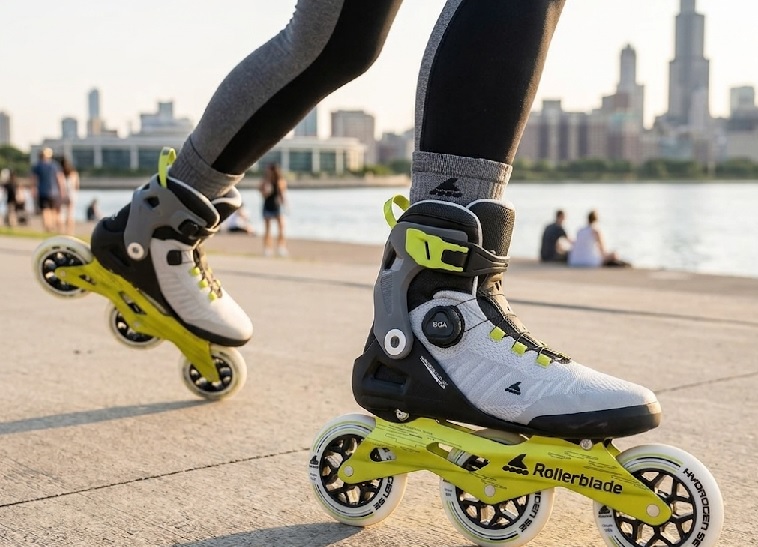
Powerslide Next Core 100 – Best for Core Stability
The Powerslide Next Core 100 uses a Trinity mounting system that lowers your center of gravity. This unique setup demands constant core activation to maintain balance. With its responsive cuff and shock-absorbing frame, it is ideal for skaters who want to strengthen their abs and obliques.
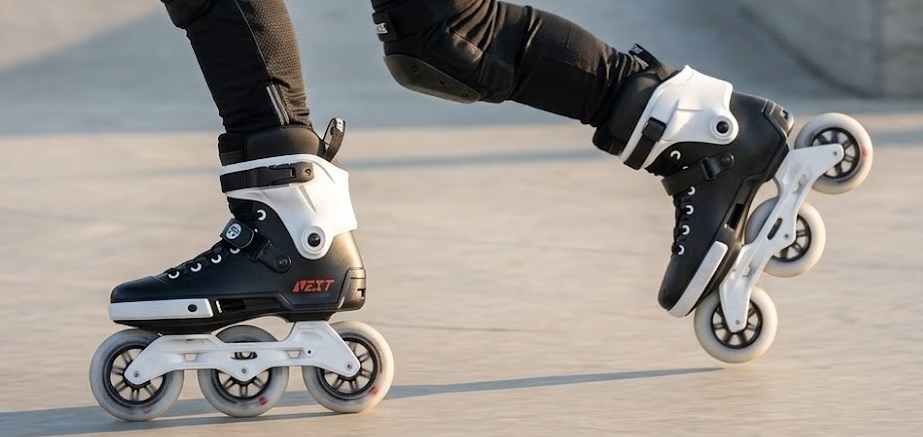
K2 F.I.T. Pro 90 – Best for Endurance Training
The K2 F.I.T. Pro 90 offers a soft boot design with excellent ankle flexibility. This encourages a natural heel-to-toe motion that fully engages the hamstrings and calves. Its lightweight construction allows for longer sessions, making it the recommended choice for building muscular endurance.
How Inline Skating Engages Your Lower Body Muscles
Inline skating is a compound movement that mimics the lateral lunge. This motion recruits multiple muscle groups simultaneously, offering exceptional efficiency for strength and cardio.
Glutes and Quadriceps: The Primary Power Drivers
Your glutes and quads are the main engines during the push-off phase. As you extend your leg outward and backward, these muscles generate the force needed for propulsion.
- Gluteus Maximus: Activates during the final push-off to extend the hip. This builds strength and shape in the buttocks.
- Quadriceps: Work isometrically to stabilize the knee and concentrically during leg extension. They are constantly engaged to maintain a low skating stance.
Hamstrings and Calves: Stabilizers and Finishers
Your hamstrings control the recovery phase, pulling the skate back under your body. Your calves provide the final flick of the ankle for a complete stride.
Hamstrings: They decelerate the leg after the push-off, preventing hyperextension. Calves (gastrocnemius and soleus): They point the toe at the end of each stride, adding extra power and maintaining ankle stability.
Key Takeaway: The glutes and quads drive the power, while the hamstrings and calves control the motion. This balanced engagement prevents muscle imbalances common in running or cycling.
Hip Adductors and Abductors: The Lateral Movers
Inline skating requires constant lateral stabilization. Your hip adductors (inner thighs) pull the leg inward during the glide, while your hip abductors (outer hips) control the outward push-off. This makes skating an excellent exercise for toning the inner and outer thighs.
Core and Upper Body Muscle Activation in Inline Skating
While inline skating is famous for its leg workout, your core and upper body play a critical supporting role. These muscles maintain posture and transfer power efficiently.
Core Muscles: The Stability Center
Your abdominals, obliques, and lower back work isometrically to keep your torso upright and balanced. Every glide and turn forces these muscles to contract to prevent you from falling.
- Rectus Abdominis: Engaged to maintain a forward lean without hunching. This prevents lower back strain during long skates.
- Obliques: Activate during crossovers and turns. They control rotational forces generated by your hips and legs.
- Erector Spinae: Works to keep your spine aligned against the pull of gravity and momentum.
Upper Body: The Counterbalance
Your arms swing in opposition to your legs, just like running. This natural motion engages the shoulders, biceps, and upper back.
Shoulders and Traps: They hold your arms in a bent position while swinging. Biceps: They maintain the arm angle against wind resistance. This upper body engagement increases your overall calorie burn by involving more muscle mass.
Key Takeaway: A strong core prevents falls and improves efficiency. Pumping your arms deliberately can increase calorie expenditure by up to 15%.
How Skating Compares to Other Cardio Exercises
Unlike cycling, which limits upper body involvement, skating requires full-body coordination. Running provides similar leg engagement but lacks the lateral glute activation that skating offers.
| Exercise | Primary Muscles | Core Engagement |
|---|---|---|
| Inline Skating | Glutes, Quads, Calves | High |
| Running | Hamstrings, Quads, Calves | Moderate |
| Cycling | Quads, Hamstrings | Low |
How to Maximize Muscle Activation While Inline Skating
Simply skating casually will engage your muscles, but specific techniques can dramatically increase the workload. Use these proven methods to turn your skate session into a targeted strength workout.
Lower Your Stance for Greater Leg Engagement
A deeper skating stance forces your quads and glutes to work harder. Bend your knees to a 90-degree angle and keep your chest up.
- Shallow stance: Engages muscles at 40% capacity. Good for beginners or recovery skates.
- Moderate stance: Engages muscles at 60% capacity. Ideal for general fitness skating.
- Deep stance: Engages muscles at 85% capacity. Best for building strength and endurance.
Use Powerful, Explosive Strides
Short, choppy steps limit muscle recruitment. Focus on long, powerful pushes that fully extend your leg.
Step 1: Push off from the heel, driving through the ball of your foot. Step 2: Fully extend your leg until your knee is straight. Step 3: Glide on one foot for at least two seconds before switching. This maximizes time under tension for your glutes and hamstrings.
Incorporate Hill Training and Intervals
Skating uphill is a resistance workout for your lower body. It forces your glutes and quads to produce more force with every stride.
- Hill climbs: Build explosive strength in the glutes and quads. Keep strides short and powerful.
- Interval sprints: Skate at maximum effort for 30 seconds, then recover for 60 seconds. This boosts fast-twitch muscle fiber activation.
Key Takeaway: A deep stance, full extension, and hill climbs are the three most effective ways to increase muscle activation. Combine them for the best results.
Add Crossover Drills for Inner and Outer Thighs
Crossover steps are not just for turning. They specifically target your hip adductors (crossing leg) and hip abductors (supporting leg). Practice figure-eight patterns to engage these often-neglected muscles.
Common Mistakes That Reduce Muscle Engagement While Skating
Even experienced skaters often make errors that limit muscle activation. Fixing these mistakes can instantly improve the effectiveness of your workout.
Skating with a Straight Back and Locked Knees
A stiff, upright posture shifts the workload from your glutes to your lower back. This reduces muscle engagement and increases injury risk.
- The problem: Straight legs mean your quads and glutes barely contract. Your lower back takes the strain instead.
- The fix: Keep your knees bent at all times. Imagine sitting in an invisible chair while you glide.
- Result: Your quads will burn within minutes, signaling proper activation.
Taking Short, Choppy Strides
Many beginners take quick, small steps to feel more stable. This prevents full leg extension and limits muscle recruitment.
The problem: Short strides only use the quads and calves. The glutes and hamstrings remain largely inactive. The fix: Focus on pushing your skate out to the side until your leg is fully straight. Glide on each foot for three seconds.
Neglecting Arm Swing and Core Engagement
Letting your arms hang limp or holding them stiffly reduces calorie burn. It also throws off your balance.
- The problem: Without arm swing, your core doesn’t need to stabilize rotation. This halves your total-body workout.
- The fix: Pump your arms in opposition to your legs. Right arm forward with left leg forward.
- Result: Your obliques and shoulders will engage, boosting your calorie burn by up to 20%.
Key Takeaway: Bent knees, long strides, and active arm swings are non-negotiable for a full-body workout. Fix these three mistakes to see immediate results.
Skating Only on Flat, Smooth Surfaces
Flat terrain provides no resistance variation. Your muscles adapt quickly, and progress stalls.
The fix: Seek out gentle hills, rough pavement, or grass paths. These surfaces force your stabilizer muscles to work harder, leading to greater strength gains and improved balance.
Sample Inline Skating Workout for Maximum Muscle Growth
To effectively target all the muscles inline skates work, you need a structured routine. This 30-minute workout combines strength, endurance, and stability training.
Warm-Up: 5 Minutes of Muscle Activation
Prepare your body with dynamic movements before skating. This reduces injury risk and improves performance.
- Bodyweight squats: 15 reps to activate glutes and quads.
- Leg swings: 10 swings per leg forward and side-to-side for hip mobility.
- Easy skating: 2 minutes at a gentle pace to increase blood flow.
Main Set: 20 Minutes of Targeted Work
Perform each drill for 3 minutes with 1 minute of active recovery between sets. Focus on form over speed.
- Deep stance glides: Skate with knees bent at 90 degrees. Hold for 3 seconds on each foot. Targets: Quads and glutes.
- Power strides: Push off explosively and extend your leg fully. Glide for 4 seconds per leg. Targets: Glutes and hamstrings.
- Crossover figure-eights: Skate in a figure-eight pattern. Cross one foot over the other on turns. Targets: Adductors and abductors.
- Hill repeats: Find a gentle slope. Skate up with powerful strides. Coast down for recovery. Targets: Glutes and calves.
Cool-Down: 5 Minutes for Recovery
End your session with static stretches to improve flexibility and reduce soreness.
- Quad stretch: Hold for 30 seconds per leg.
- Hamstring stretch: Reach for your toes while seated on the ground.
- Glute stretch: Pull one knee across your chest while lying on your back.
Key Takeaway: This 30-minute workout hits every major muscle group. Repeat it 3 times per week for visible strength gains in 4 weeks.
Progression Plan for Continued Gains
As you get stronger, increase the challenge to avoid plateaus. Add 5 minutes to the main set each week. Increase hill incline gradually. Switch to a three-wheel skate setup for deeper glute activation due to the larger wheel diameter.
Inline Skating vs. Other Cardio: Muscle Engagement Compared
Understanding how inline skating stacks up against other popular exercises helps you choose the best workout for your goals. Each activity targets muscles differently.
Inline Skating vs. Running: Lateral vs. Linear Movement
Running is a forward-only motion that primarily works the hamstrings and calves. Inline skating adds a lateral push that engages the glutes and inner thighs.
- Running: Hamstrings do 60% of the work. Glutes only activate during uphill sprints.
- Inline Skating: Glutes do 50% of the work. The lateral push-off recruits the hip abductors and adductors.
- Verdict: Skating builds a more balanced lower body with stronger glutes and inner thighs.
Inline Skating vs. Cycling: Full Body vs. Isolated Movement
Cycling isolates the quads and hamstrings in a fixed, seated position. It offers minimal core or upper body engagement.
- Cycling: Quads do 70% of the work. Core and arms remain largely static.
- Inline Skating: Quads do 40% of the work. Core, arms, and stabilizers are constantly active.
- Verdict: Skating provides a superior full-body workout with higher calorie burn per hour.
Inline Skating vs. Swimming: Weight-Bearing vs. Non-Weight-Bearing
Swimming is non-weight-bearing, which is gentle on joints but does not build bone density. Skating is weight-bearing, which strengthens bones and joints.
- Swimming: Excellent for upper body and core. Limited leg muscle activation compared to skating.
- Inline Skating: Builds bone density in the hips and spine. Strengthens joints through impact absorption.
- Verdict: Skating is better for long-term bone health and lower body strength.
Key Takeaway: Inline skating offers the best balance of lower body strength, core stability, and bone health. It is a superior alternative to running and cycling for full-body conditioning.
Calorie Burn Comparison Per 30 Minutes
For a 155-pound person, inline skating burns approximately 260 calories. Running at 6 mph burns 300, while cycling at moderate pace burns 230. Skating offers a competitive calorie burn with added muscle-building benefits.
Safety Tips to Prevent Injury While Building Muscle
Proper safety practices ensure you can skate consistently without setbacks. Injuries derail progress, so prevention is key for long-term muscle development.
Wear Proper Protective Gear at All Times
Falling is inevitable when learning new techniques. Wearing gear protects your joints and allows you to push harder without fear.
- Wrist guards: Prevent 87% of wrist fractures during falls. Always wear them, even as an expert.
- Knee pads: Allow you to drop into deep stances confidently. They protect against impact and road rash.
- Helmet: Protects against traumatic brain injury. Choose a CPSC-certified skate helmet for proper coverage.
Master the Fall Before Pushing Intensity
Knowing how to fall safely reduces injury risk dramatically. Practice this on grass before attempting high-intensity drills.
- Bend your knees: Lower your center of gravity before impact.
- Tuck your chin: Prevent your head from hitting the ground.
- Slide on your pads: Land on your knee pads and wrist guards. Do not catch yourself with straight arms.
Listen to Your Body and Rest Appropriately
Muscles grow during recovery, not during the workout. Overtraining leads to fatigue, poor form, and injury.
- Rest days: Take at least one full rest day between intense skating sessions.
- Pain vs. soreness: Muscle soreness is normal. Sharp or joint pain means stop immediately.
- Hydration: Drink water before, during, and after skating. Dehydration causes muscle cramps and poor performance.
Key Takeaway: Gear, proper falling technique, and adequate rest are non-negotiable. They keep you skating longer and building muscle consistently.
Choose the Right Surface for Your Skill Level
Smooth asphalt is ideal for beginners. Rough pavement and concrete require more stabilizer muscle engagement but increase fall risk. Start on smooth surfaces, then progress to challenging terrain as your balance improves.
Conclusion: Master the Muscles Inline Skates Work
Inline skating is a complete lower-body workout that targets your glutes, quads, hamstrings, calves, and core. It also engages your upper body for balance and power transfer.
Your best practice: Use a deep stance, powerful strides, and active arm swings to maximize muscle activation. Combine this with hill training and interval drills for rapid strength gains.
Put on your skates and apply these techniques today. Your muscles will feel the difference in just one session.
Frequently Asked Questions about What Muscles Inline Skates Work
Does inline skating build muscle or just tone it?
Inline skating builds functional muscle, particularly in the glutes, quads, and calves. The resistance from pushing against the ground and maintaining a low stance creates enough tension for hypertrophy.
To build visible muscle, combine skating with progressive overload. Skate harder, longer, or on steeper hills each week. Pair this with adequate protein intake for optimal muscle growth.
Will inline skating make my thighs bigger?
Yes, inline skating will develop your quadriceps and hamstrings, which can increase thigh size. The degree depends on your genetics, intensity, and diet.
For leaner thighs, focus on longer, moderate-paced skates rather than explosive sprints. For more muscular thighs, incorporate hill climbs and deep stance glides. Both approaches strengthen the legs effectively.
How many calories does inline skating burn per hour?
A 155-pound person burns approximately 520 calories per hour of recreational inline skating. Increasing your speed or skating uphill can raise this to 800 calories per hour.
Calorie burn depends on body weight, intensity, and terrain. Using active arm swings and a deep stance increases energy expenditure by up to 20% compared to casual skating.
Is inline skating better for glutes than running?
Yes, inline skating activates the glutes more effectively than running. The lateral push-off motion recruits the gluteus maximus and medius to a greater degree than running’s forward-only motion.
Running primarily targets the hamstrings and calves. Skating’s side-to-side movement pattern makes it superior for building and toning the glutes.
Can inline skating replace leg day at the gym?
Inline skating can supplement leg day but should not fully replace resistance training. Skating builds endurance and functional strength but lacks the progressive overload of weighted squats and lunges.
For best results, combine skating with two gym sessions per week. Use skating for cardio and endurance, and use weights for maximum strength and hypertrophy.
How often should I skate to see muscle results?
Skate three to four times per week for visible muscle changes within four to six weeks. Each session should last at least 30 minutes with focused intensity.
Consistency is more important than duration. A focused 30-minute session with proper technique yields better results than a two-hour casual skate.
Does inline skating work your abs and core?
Yes, inline skating works your core muscles constantly. Your abdominals, obliques, and lower back contract isometrically to keep you balanced and upright.
Every glide, turn, and crossover forces your core to stabilize your torso. Adding arm pumps and maintaining a forward lean increases core engagement significantly.
What muscles do inline skates work compared to cycling?
Inline skating works more muscles overall than cycling. Skating engages the glutes, quads, hamstrings, calves, core, and upper body. Cycling primarily targets the quads and hamstrings.
Cycling is seated and limits core and arm engagement. Skating requires full-body coordination, making it a more complete workout for total muscle development.
Is inline skating good for weight loss?
Yes, inline skating is excellent for weight loss. It burns 400-800 calories per hour while building lean muscle that increases your resting metabolism.
The combination of cardio and resistance training makes skating more effective than steady-state cardio alone. Pair it with a calorie-controlled diet for optimal fat loss results.
What should I wear to maximize muscle activation?
Wear supportive inline skates that fit snugly. Loose skates reduce power transfer and limit muscle engagement in the glutes and quads.
Choose form-fitting athletic clothing that allows full range of motion. Avoid baggy pants that restrict leg extension during powerful strides.